OurVision.
Beyond Remittance Group (BRG) envisions a transformed Simawa High School that becomes far more than a rehabilitated public school — a sustainable, inclusive, future-ready K–12 learning community that demonstrates what is possible when government, educators, community stakeholders, and the African diaspora come together to invest not simply in a school, but in children, knowledge, opportunity, and the future of a community.
Beyond Remittance Group envisions Simawa High School as a sustainable K–12 model of educational excellence and equity — a school where learning extends beyond the classroom, where agriculture meets innovation, where technology meets creativity, where culture meets global citizenship, and where the built environment itself becomes a teacher.
From Adoption to Action
BRG's adoption of Simawa High School in 2022 under the Public–Private Partnership for Education Equity (PPP4EE) initiative was never conceived as a one-time charitable intervention. It was intended to establish a sustained partnership focused on improving the educational experience and expanding opportunities for students.
Since 2022, BRG has worked directly to address some of the school's immediate needs while simultaneously laying the foundation for long-term transformation — hiring additional teachers, providing school supplies, supporting the feeding of students, and investing in academic enrichment programs. These interventions are driven by a simple principle: educational equity begins with ensuring that students have the basic resources, human support, and learning environment necessary to succeed.
BRG's Immersive Reading and Writing Summer Program goes beyond conventional literacy by exposing students to literature and storytelling that preserve indigenous knowledge, culture, history, and identity. Students are encouraged not only to read and write, but to understand the importance of their own stories and the knowledge embedded within their cultural traditions — reflecting BRG's broader philosophy that education should prepare young people for the future without disconnecting them from their heritage.
The results of this sustained engagement have reinforced BRG's conviction that strategic investment in public education can produce meaningful change — part of a larger story of students supported to remain engaged, complete their education, and move confidently toward the next stage of their lives.
In 2026, BRG launched arts programming at Simawa High School, recognizing that education must develop the whole child. The arts provide students with opportunities for creative expression, confidence-building, cultural exploration, collaboration, and exposure to potential pathways within the creative economy. This growing integration of literacy, indigenous knowledge, arts, technology, entrepreneurship, and practical learning is central to BRG's vision for the future of Simawa High School.
- Teachers hired and allocated
- School supplies provided
- Students fed daily
- Immersive Reading & Writing Summer Program launched
- Indigenous literature incorporated into curriculum
- Arts programming introduced (2026)
- Highest graduate count achieved with Class of 2022
- Six additional teachers allocated by Ogun State Government
"Diaspora engagement can be catalytic. Government partnership can make the intervention sustainable. And the school and community remain at the centre of both."
BRG's engagement has helped bring attention to the school's continuing need for human resources. Through the organisation's ongoing dialogue with the Ogun State Government, six additional teachers have now been allocated to Simawa High School.
This represents an important evolution in the adoption model. BRG is not seeking to permanently substitute for government responsibility — rather, its goal is to catalyze investment, identify needs, mobilize resources, demonstrate possibilities, and work with government to create sustainable solutions. The allocation of six additional teachers demonstrates the potential of that partnership.
A K–12 Learning Community
What could Simawa High School become if today's interventions were transformed into a permanent educational ecosystem?
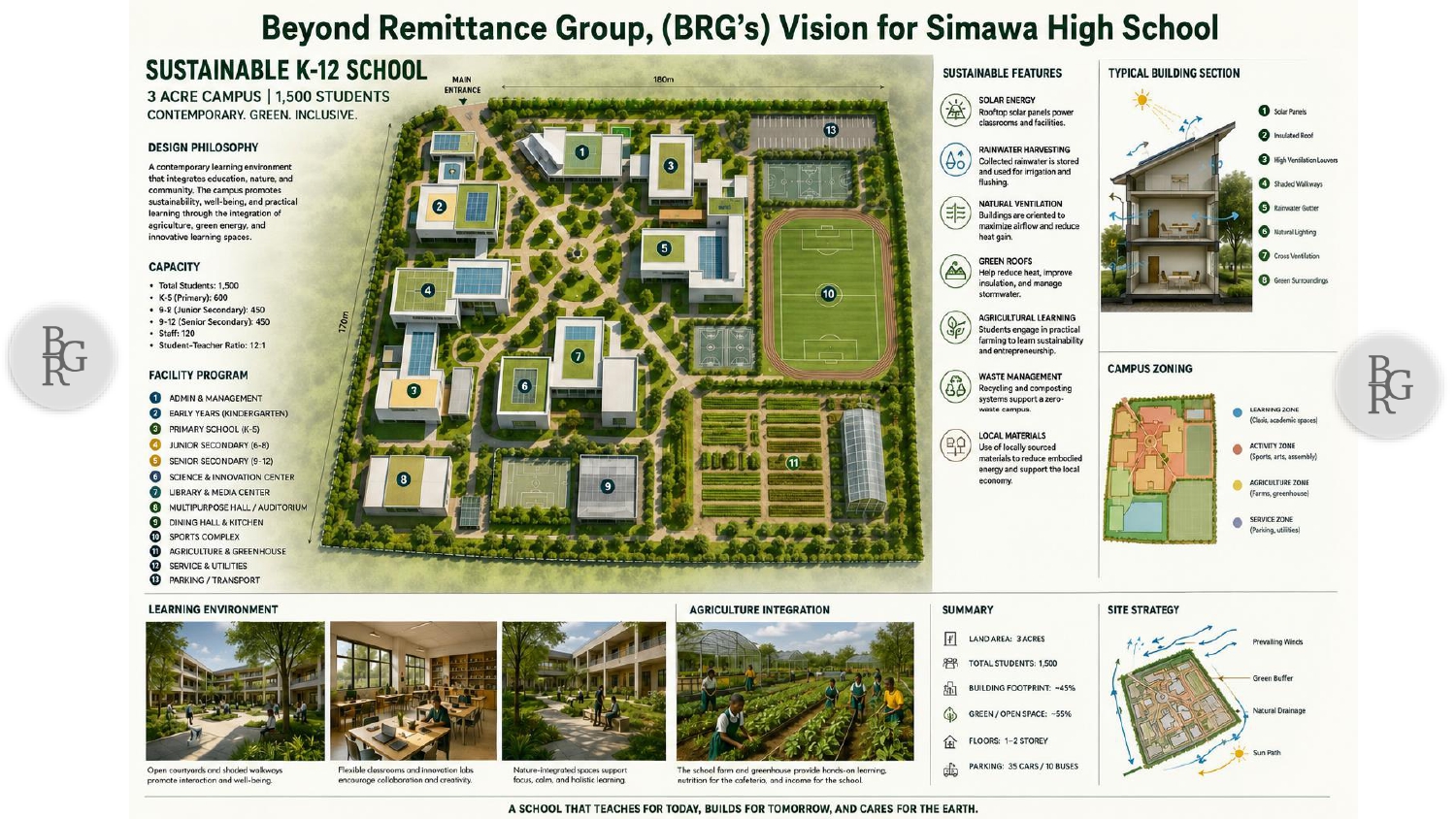
BRG envisions a three-acre K–12 campus serving approximately 1,500 students, creating an educational continuum from Kindergarten through Grade 12. Rather than simply adding classrooms, the proposed campus creates distinct but interconnected environments — a school where every part of the campus contributes to learning.
The campus brings together Science + Technology + Arts + Culture + Agriculture + Entrepreneurship + Sports + Civic Responsibility — preparing students not merely to pass examinations, but to become problem-solvers, innovators, creators, entrepreneurs, and responsible citizens.
- Early Years & Kindergarten
- Primary School (K–5)
- Junior Secondary (6–8)
- Senior Secondary (9–12)
- Science & Innovation Center
- Library & Media Center
- Arts & Creative Learning
- Agriculture & Greenhouse
- Sports Complex
- Multipurpose Auditorium
- Dining Hall & Kitchen
- Admin & Community Hub
The campus itself becomes a living laboratory.
These are not simply sustainable architectural features — they are opportunities for learning. A student studying renewable energy can see solar technology operating on the school. A student studying environmental science can observe water conservation and natural drainage. A student studying agriculture can walk from the classroom into the school garden and greenhouse. A student studying entrepreneurship can understand how agricultural production becomes an economic enterprise.
Rooftop panels power classrooms and facilities.
Collected for irrigation and flushing.
Reduce heat, improve insulation, manage stormwater.
Students engage in practical farming and entrepreneurship.
Recycling and composting support a zero-waste campus.
Locally sourced construction reduces embodied energy.
Buildings oriented to maximise airflow and reduce heat gain.
Green surroundings that keep the campus cool and comfortable.
Growing space woven through the campus, beyond the greenhouse.
Agriculture & Entrepreneurship
The proposed Agriculture Zone and greenhouse let students engage directly with farming, nutrition, environmental stewardship, food systems, technology, and entrepreneurship — learning the journey from seed to harvest to market. Agriculture becomes a classroom for science, economics, environmental education, nutrition, entrepreneurship, and community development.
Science, Technology & Innovation
A proposed Science & Innovation Center and Library & Media Center expand STEM, digital literacy, research, and information access for every student.
Arts, Culture & Indigenous Knowledge
BRG believes modernisation must not erase identity. Literature, storytelling, and arts programming ensure students are globally connected but locally grounded.
Sports, Wellness & Civic Responsibility
Sports facilities, communal spaces, and an auditorium make the school an anchor institution — where health, teamwork, and community life intersect.
Preserving Indigenous Knowledge While Preparing for the Future
The Immersive Reading and Writing programs' focus on literature that preserves indigenous knowledge reflects this philosophy. Modernisation must not come at the expense of cultural identity — BRG believes students should move confidently into a globalised world while understanding where they come from. Their education should allow them to ask: Who are we? What knowledge have our communities preserved? What can we learn from our elders? How can we preserve our stories? And how can we use that knowledge to shape the future?
The K–12 vision therefore seeks to create a school that is globally connected but locally grounded.
Ultimately, BRG sees Simawa High School becoming an anchor institution for the community — a place where education, culture, community development, and economic opportunity intersect.
- A community institution, not just a school
- Auditorium for cultural and community events
- Library as a resource for lifelong learning
- Agricultural facilities for practical training
- Arts spaces that encourage creativity
- Technology that connects students to the world
From Remittance to Legacy
Traditional remittances help families meet immediate needs. BRG seeks to explore what happens when diaspora resources are directed toward long-term investments in human capital and institutions. At Simawa, that philosophy is already visible — since 2022, BRG has moved from adoption to active intervention:
- Teachers have been added
- School supplies have been provided
- Students have been fed
- Literacy programs have been created
- Indigenous knowledge has been incorporated into learning
- Arts programming has been introduced
- Student achievement has been supported
- Government has responded with six additional teachers
The architectural master plan represents the opportunity to bring these individual interventions together within a coherent, sustainable educational ecosystem.
We envision a school where a child can enter as a young learner and graduate prepared not only for higher education and employment, but to create, innovate, lead, and contribute to the development of their community. This is BRG's vision of moving beyond remittance to legacy: transforming diaspora goodwill into lasting human-capital investment, and building a model of what partnership between the diaspora, government, and community can achieve.
A school that teaches for today,builds for tomorrow.
It preserves where we come from, and prepares the next generation to lead. This vision is built on partnership — between the diaspora, the government, educators, and the community. There is a place for you in this work.
Beyond Remittance Group — Building Human Capital, Building Futures